Arabic-First by Design: Why Localisation Starts Before Translation
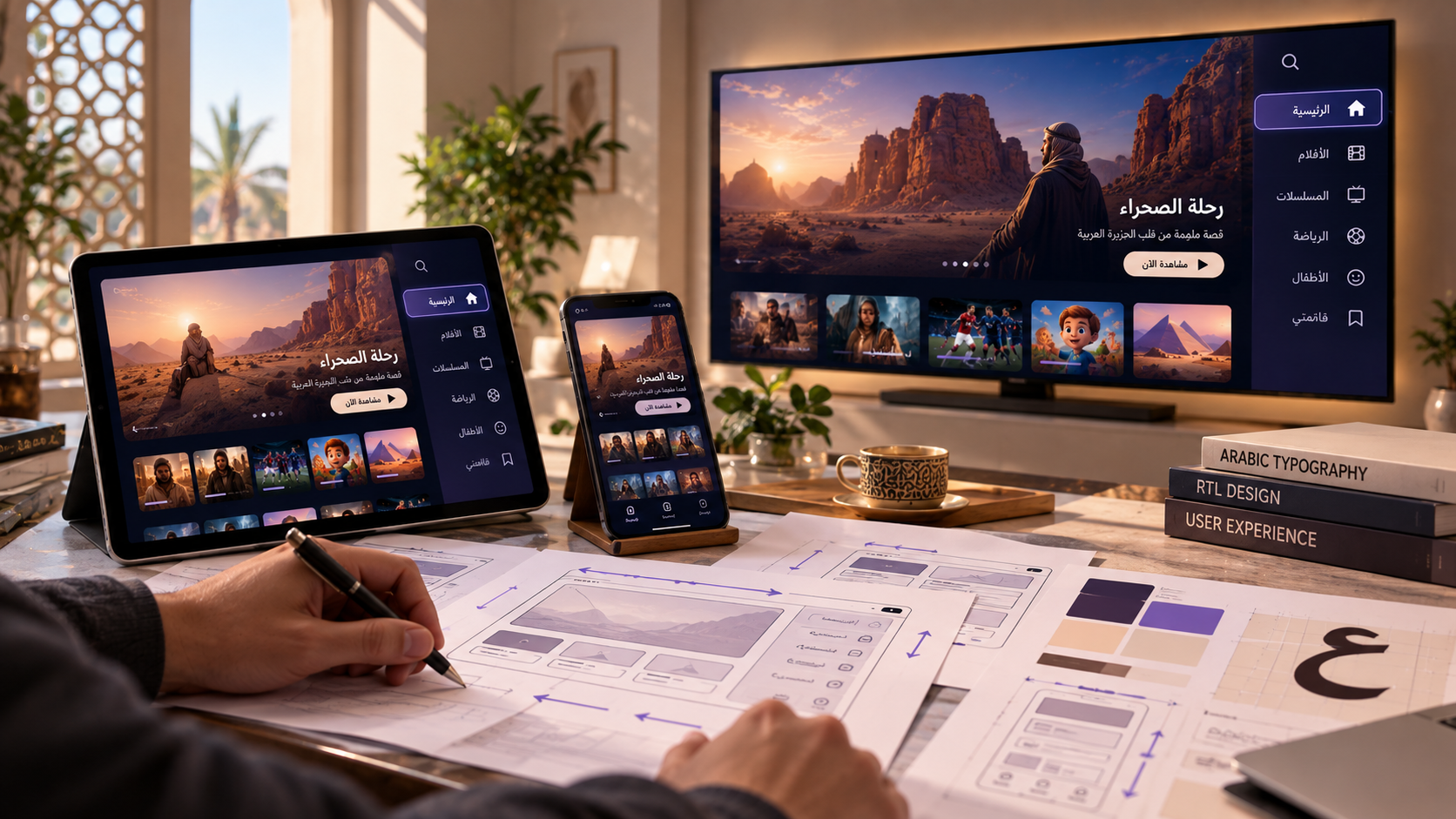
Culturally meaningful digital products are built from the first design decision, not added as a finishing touch.
Translation is only one layer
A digital product can display Arabic words and still feel as though it was designed for someone else. Labels may be translated while navigation remains awkward, content hierarchy feels unfamiliar or the visual rhythm does not support right-to-left reading. These details shape the experience long before a person evaluates the words themselves.
Arabic-first design asks a more useful question: what changes when the language and its audiences are considered from the very beginning? The answer touches research, layout, typography, interaction, content strategy and product validation.
The standards explain the design challenge
The W3C's October 2025 Arabic and Persian Layout Requirements note says Arabic-script content is written right to left, while numbers and embedded left-to-right scripts need their own handling. The W3C's HTML guidance also covers how authors should mark up bidirectional content. A translated label cannot, by itself, solve the behaviour of an entire interface.
Start with structure
Right-to-left thinking affects more than the direction of a paragraph. Teams need to consider the reading order of information, the placement and behaviour of navigation, focus states, mixed-language content and the relationship between text and visual components. Television interfaces add their own demands, including viewing distance and directional remote-control navigation.
The goal is not to mirror every element mechanically. It is to create a coherent experience in which each choice has a purpose. This requires design and engineering to work together, particularly when shared components are used across TV, web and mobile.
Mixed-language content is not a corner case
Unicode's Bidirectional Algorithm addresses the display of lines containing both left-to-right and right-to-left characters. That matters in interfaces containing Arabic programme names alongside Latin brand names, dates, numbers or technical terms. The practical design lesson is to test realistic mixed-content screens instead of relying only on clean demonstration layouts.
Culture lives in the everyday details
Cultural relevance should not be reduced to decorative patterns or a generic image of the region. It appears in the stories people recognise, the words they use, the expectations they bring to a shared family screen and the way content is organised for discovery.
It also requires curiosity. Arabic-speaking audiences are diverse, and their preferences cannot be compressed into a single persona. Research and validation should leave room for different markets, generations and use cases. Authenticity is a discipline of listening, not a visual shortcut.
Accessibility belongs in the same conversation
WCAG 2.2 addresses accessibility across a range of devices and user needs. Its scope is web content, so it should not be misrepresented as a certification of an OORO television interface. Its principles nonetheless provide a useful reference when planning legibility, navigation and interaction in connected experiences.
Build with trust and inclusion in mind
Clear language, predictable navigation and accessible presentation help more people participate. Family-centred thinking adds the need for meaningful choice and responsible treatment of privacy and protection. These are ongoing product commitments rather than marketing decorations.
At OORO, Arabic at Heart, Family in Mind and Innovation for Everyone express how we intend to approach connected experiences. Together, they make localisation a strategic design principle, not a late-stage production task.
Make belonging a product quality
The most effective localised experiences rarely need to announce how local they are. People recognise the difference in how comfortably they can use them. When language, interaction and cultural understanding work together, technology becomes easier to approach—and more meaningful to keep using.