One Experience, Many Screens: Why Connected Design Matters
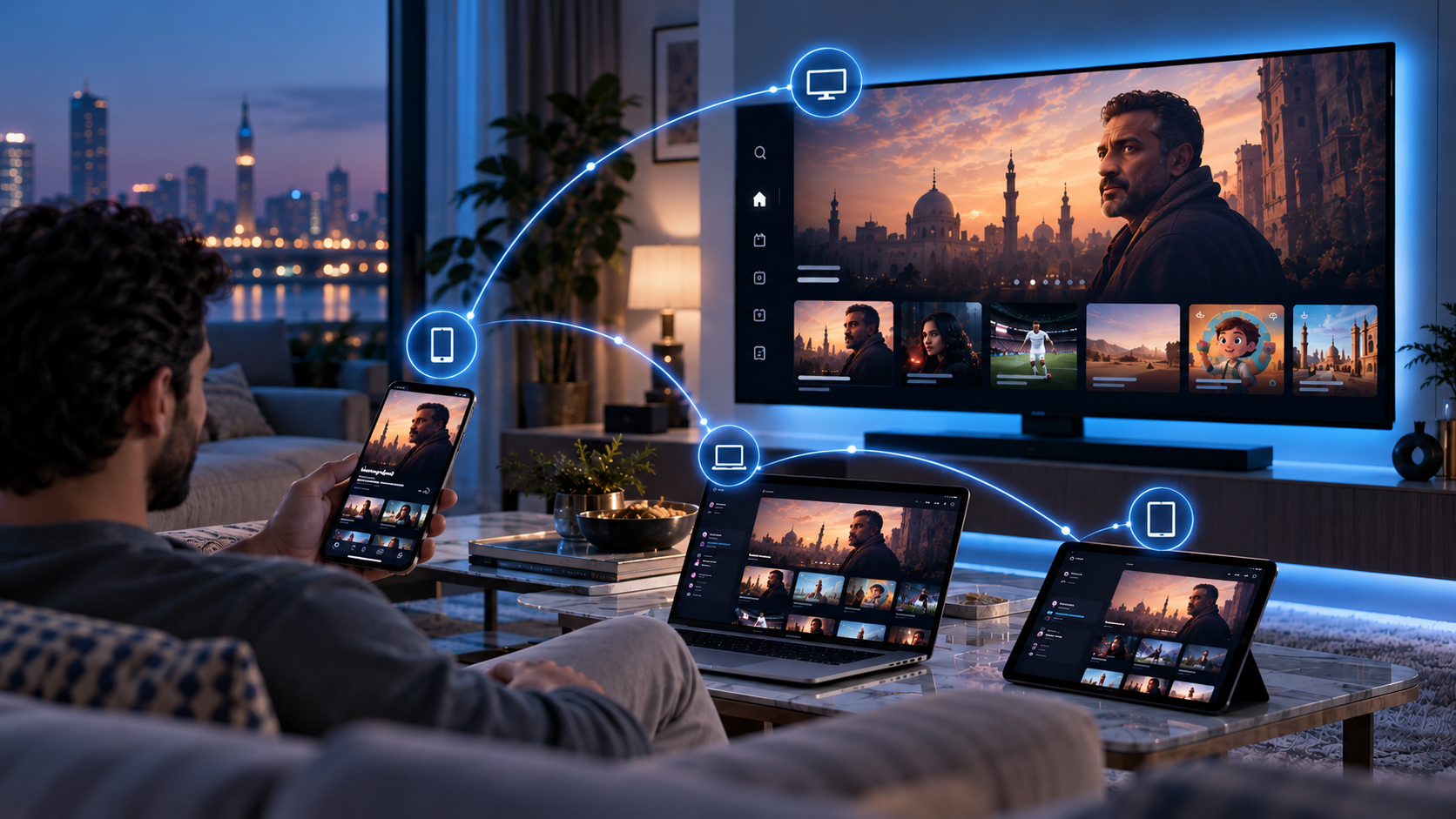
A journey can begin on a television and continue on a phone. The best connected experiences make that feel natural.
People do not think in platforms
A viewer may first notice something on the television, look for more information on a phone and return to the big screen later. A business customer may discover a service on the web and then interact with it through a connected device. These are not separate relationships in the person's mind. They are parts of one experience.
Products become frustrating when each screen behaves as if it exists alone. Familiar controls move unexpectedly, terminology changes and users have to learn the same task again. Connected experience design begins by looking at the complete journey rather than a collection of isolated interfaces.
Connected audiences are already here
GSMA's Mobile Economy MENA 2025 reports 308 million mobile-internet users in the region in 2024. That figure describes mobile connectivity, not the number of people using companion TV applications. Still, it provides a concrete backdrop for considering how a television experience and a phone experience can work together.
Consistency is more than matching colours
A shared visual identity matters, but a connected design language goes further. Navigation patterns, interaction principles, component behaviour, information architecture and feedback states should make sense together. A television requires distance-friendly legibility and remote-control navigation. A phone depends on touch and a different viewing context. Consistency means preserving the logic while adapting the interaction.
That balance is especially important for companion experiences. The OORO Companion App, for example, is positioned as a mobile remote control and TV device manager—not an entertainment app catalogue. The relationship between the phone and television should therefore be easy to understand, with supported controls and management functions represented accurately.
A recognised design baseline
The W3C's WCAG 2.2 guidance applies to web content across device types, including desktop and mobile. It addresses issues such as accessibility for people with visual, hearing, movement and cognitive disabilities. For connected design teams, it is a reminder that consistency should be accompanied by legibility, operability and inclusive interaction—not merely shared colours.
Design and engineering need the same conversation
A promising prototype is only the beginning. Real products depend on practical specifications, implementation reviews, interaction guidelines and quality validation. Designers need to understand the opportunities and constraints of the target platform. Engineers need clarity about intended behaviour and the details that make an experience coherent.
OORO's capability catalogue describes digital experience work across TV OS and smart TV interfaces, responsive web, iOS and Android, companion experiences, shared design systems and developer-ready handoff. Bringing these capabilities into one process helps reduce the distance between a design intention and the experience a person eventually uses.
Why the handoff matters
RDK's public documentation describes a modular video architecture with vendor, core and application layers, allowing components to be developed and tested with clearer boundaries. OORO's own catalogue describes developer-ready UI specifications, implementation reviews and shared components. These are different kinds of evidence: RDK documents an industry architecture; the OORO catalogue documents our proposed service scope.
Build the journey before polishing the screens
A useful starting point is to map the moments that matter: discovery, first interaction, routine use, returning to a task and getting help. Then identify which device is best suited to each moment. Only after that should teams settle the detailed screen-by-screen behaviour.
When this approach works, the technology does not call attention to the boundaries between devices. People simply feel that the experience understands what they are trying to do.